Robert Joanny : écrivain français : « …l’interrogation sur l’identité est, souvent, la source ou du moins le corollaire d’un changement de langue, qui n’a pas pour seule vocation d’exprimer un refus, mais bien de répondre à un désir de reconstruction ».
[“…the question of identity is often the source of, or at least the consequence of a language change, of which the sole purpose is not to express refusal, but to respond to a desire for reconstruction.”]
Language and identity are inextricably entwined. When one language is lost, or abandoned, or forcefully eradicated from the mouths of its speakers and replaced by another, identities inevitably shift. The language we speak influences every relationship, both personal and material : to ourselves, to others, to the spaces we live and work in, to our history and to our contemporary narrative.
I have repeatedly observed and articulated that from the late 19th century through today, the baseline for identity in Louisiana shifted from language and culture to race and skin color as a direct result of heritage language loss, forced assimilation into English, and Americanization.
Everything we are taught about our own history, culture and heritage languages as Louisianians is projected from an American, monolingual English-speaking perspective. We learn these stories in English because the role of schools is to mold children, no matter their background, into a uniform, American national identity because the majority language group always controls the politics, the economy and the historical and contemporary narrative.
This eternal, never-ending debate IN ENGLISH over the identity labels “Cajun” and “Creole” is a perfect example of this.
****
Among the very first things I remember learning about slavery was that it was illegal to teach enslaved people to read and write because KNOWLEDGE IS POWER. When people can read, they have access to information that allows them to question authority.
Stories of children being abused in school for speaking French or Creole abound in online discussion groups. By racially segregating them into separate schools for white, black and much later, indigenous children, and then forcing them speak English ensured that they were divided and conquered and controllable.
Because they were not educated in their own language they could not later, as a unified minority linguistic group, question the authority exerted over them by Americans. Nor could they become, like today’s Québécois or Acadians in Canada, a French-speaking political and economic force in 20th century Louisiana.
Sadly, many people in Louisiana categorically reject the idea of becoming literate in French, which would allow them to access historic documents, letters, literature, audio and video recordings in Louisiana French and Creole.
These written and audio archives provide a fascinating window into a world and a story that often conflicts with and is in opposition to the stories we have learned and believed and repeated about ourselves in English for the past century, including :
*that French was only an oral language in Louisiana
*that French and Creole were/are “broken” languages
*that Acadians were never considered to be Creoles
and many others that were created, emphasised and repeated with the specific goal of making people stop speaking French.
It can be destabilising and even traumatic when faced with documents, recordings or other proof that things we’ve always believed might not be true. It’s simply human nature to not want to be “wrong” and most people will reject it outright, clinging ever more fervently to their ideas, opinions and the words they use to describe things.
As an illustration, even though varieties of French have been spoken in Louisiana since at least the late 1600s, it is labeled a “foreign language” in our schools today because the dominant language and the language of educational delivery is English.
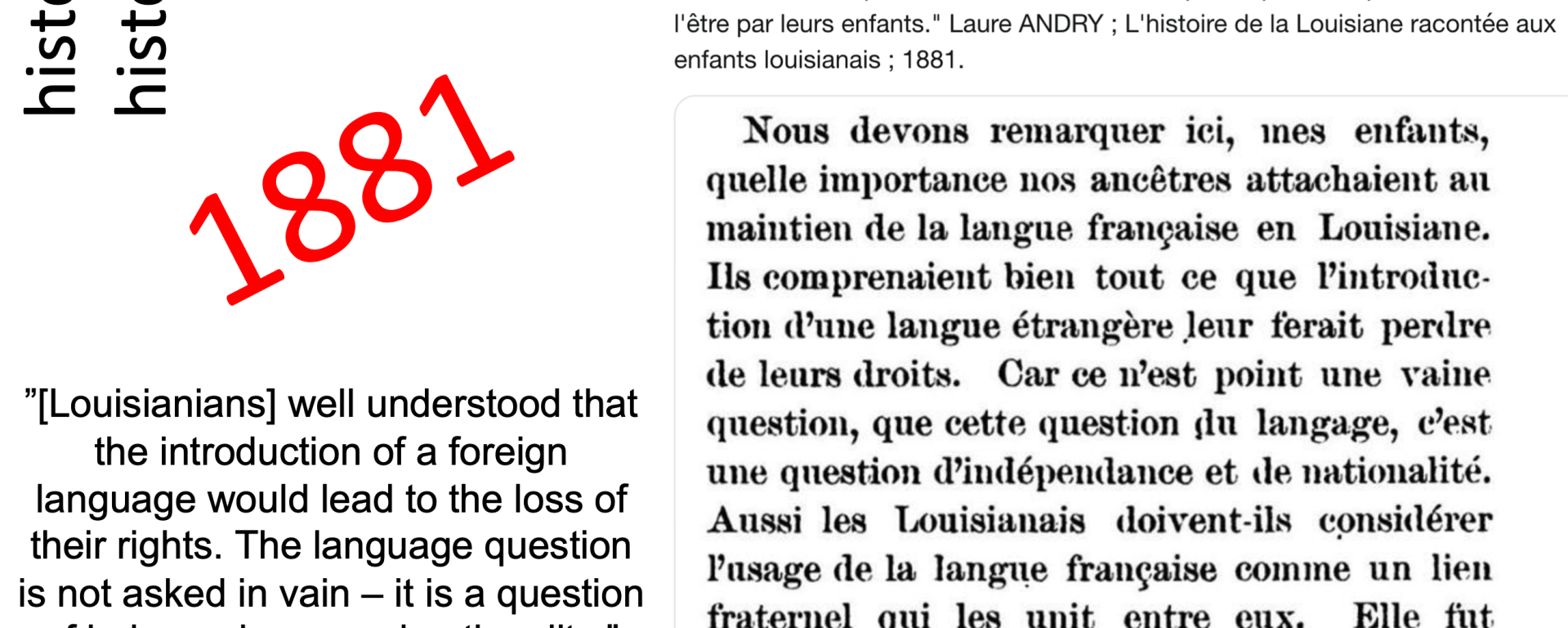
Yet, in 1881, Laure Andry wrote (in French) : ”[Louisianians] well understood that the introduction of a foreign language would lead to the loss of their rights. The language question is not a pointless one – it is a question of independence and nationality.”
For Laure Andry, and many of our ancestors, English was a foreign language that threatened their very identity (nationality).
This notion of “[a] question of independence and nationality” is vitally important in this discussion.
If we truly want French and Creole to survive and thrive in Louisiana, if we TRULY WANT IT, we must not only embrace and work toward a social, political and economic movement that happens dans ces langues, but also accept and embrace that dis-assimilation from English will also require a certain “desire for reconstruction” en français, as noted by the linguist Robert Joanny.
 louisiana | perspectives | louisianaises