
How many times have you heard someone say that people in Louisiana speak “broken” French? Have you ever wondered how or why it came to be referred to as such? This short article will attempt to explain the ways in which our French and Creole heritage languages have been purposely deconstructed, denigrated and eroded as a result of imposed English-language assimilation.
First of all, let’s address two very different concepts:
- language acquisition
- language learning
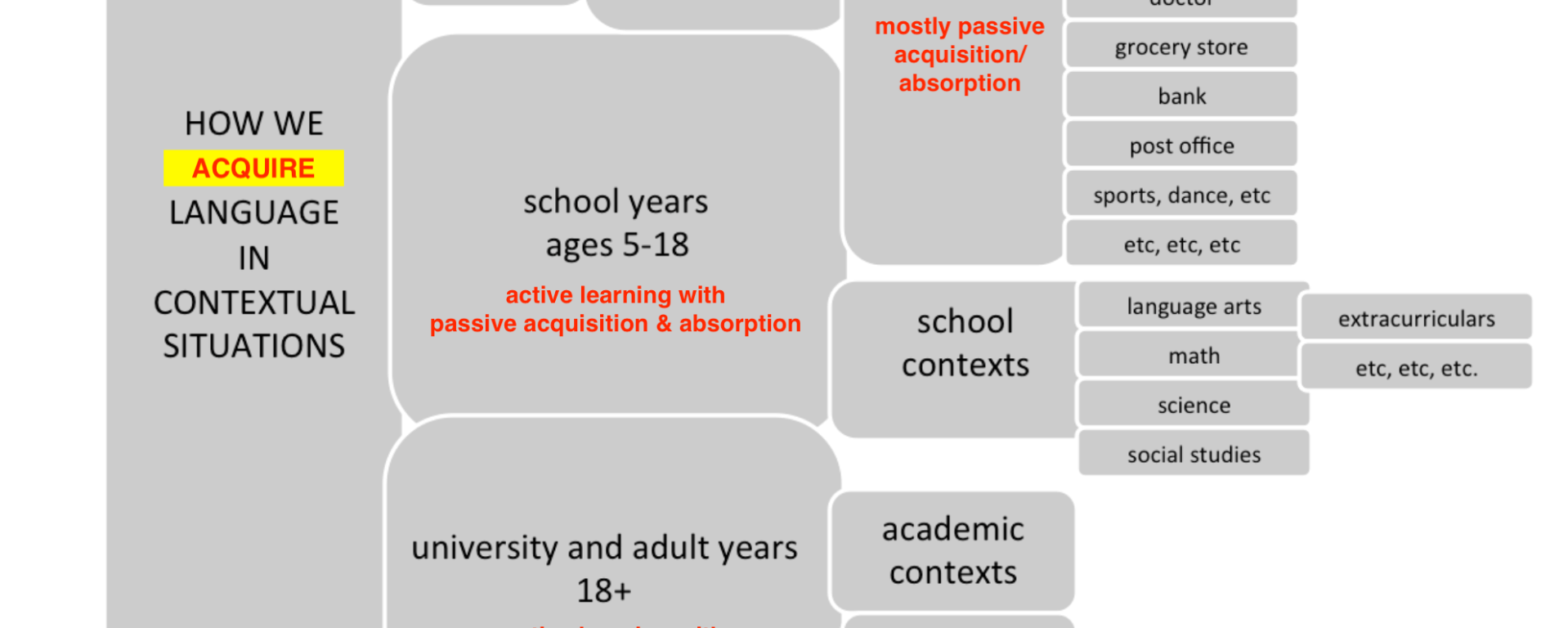
Language acquisition is passive. It is what happens from the moment we are born and begin to hear language spoken to us and around us. These are the language building blocks from birth to the beginning of the school years that allow for the earliest interactions in a language with family, friends and other people. It is the process of simple absorption of language in contextual settings, at home, in social settings, at church, at the grocery store, at the pediatrician’s office, etc.
We often hear people say that their parents didn’t “teach” them to speak French. In fact, parents do not teach their children a language. They simply speak to them in whatever language they choose to use. We don’t rock our children and conjugate verbs and grammar theory to them, we just simply talk and the children absorb the language we speak to them.
Of course, language use is often “corrected” by the parents or other speakers dependent on their own mastery of the grammar, nuances, social settings or register in any given situation. We thus first absorb the accent, vocabulary, expressions and even body language of those closest to us.
Language learning is active. It is what happens when we study a language, as in a classroom or other setting. This concept can be applied to studying a language other than our native tongue. Language learning is usually somewhat artificial in that the focus is on the study of grammar and vocabulary and not necessarily on oral expression or contextual acquisition.
For example, there is no field trip to the grocery store within the situational context of all the vocabulary, grammar and syntaxes associated with arriving at the store, choosing a shopping cart with wheels that all go in the same direction, purchasing vegetables, canned goods, etc., going through the checkout line, chatting with the cashier, paying and choosing paper or plastic. Each one of those individual pieces of the shopping trip calls for specific contextual and situational language that you won’t necessarily learn in a classroom, but which you generally have absorbed with your parents as part of this contextual building blocks I mentioned in the paragraph about language acquisition.
Rewinding the clock to before 1921 when English was imposed as the language of classroom instruction in segregated Louisiana schools, many French and Creole-speaking children, including the ancestors of people who now identify as “Cajun” and “Creole” had previously been educated in French using textbooks that came from France. These children had acquired and absorbed the initial building blocks of French/Creole at home and in their social settings and were subsequently taught their math, science, social studies, history and language arts en français. English was taught as the “foreign language.”
But, the paradigm flipped in 1921 and these same people would now be taught subject matter in the language they had previously studied as “foreign,” namely English. Over the following decades, the French-language social and economic contexts also began to shift to English. Church, grocery shopping, trips to the doctor, etc. occurred in English. As a result, the contextual language absorption shifted from French to English, thereby eroding the vocabulary and expressions associated with those situational activities.
Let’s think about this just for a moment :
Imagine the language capacity of a six year-old child, the age that you normally begin first grade (kindergarten didn’t really exist until the 1970s). Now imagine that same child speaking French or Creole at home and with family, but being forced to speak English in a public school classroom. There are many people still alive in Louisiana for whom that was a lived reality and also for whom all of the varied contextual situations outside the family setting were experienced only in English.
As a result, their French or Creole language capacity is mostly restricted to what they were able to contextually absorb before starting school. For many people, their language development in French or Creole was greatly stunted or altogether ceased when they were 6 or 7 years old. They never studied subject matter in French or French language arts in school.
And because they were programmed in English that think of their own spoken French or Creole as a foreign or bastard or “broken” language, incomprehensible to francophones from elsewhere, they now have a relational disconnect to their own language and identity.
Furthermore, TODAY, because everything that we generally consume as information about Louisiana French and Louisiana Creole is produced IN ENGLISH, our understanding of these languages within historical and contemporary contexts is all the more distorted.
This becomes even more complex when our international friends consume the same information that has been translated from English into French, they project the same myths and misinformation back onto us, so for those of us who work in the field of heritage language activism, we are constantly in defense mode both on the homefront and internationally.
In English, we acquire and absorb new vocabulary, terms, expressions, etc. without even thinking about it because we are constantly exposed to English in our daily lives, socially, professionally, and through every imaginable print and broadcast medium. You’re reading this in English and may have never considered any of these ideas, but because you consume written and spoken English, you understand what is being communicated. If you were constantly exposed to French in a variety of settings in spoken and written contexts, you would also be able to read and understand this en français.
In closing, we simply must begin to create more content, imagine more social and professional spaces, and expose ourselves to and immerse ourselves in French and Creole as often as possible in modern, contemporary settings and contexts. Our Acadian cousins and friends and other minority Francophone groups in Canada have created some excellent models that we can borrow and adapt to our Louisiana reality.
English isn’t static. It constantly evolves. None of us speaks English like our grandparents did.
So we must also begin to think of Louisiana French and Creole language acquisition and learning on a spectrum of continuum and never, ever in a vacuum or fixed in time. The truth is that they never have been due to constant contact with francophones and créolophones from Louisiana and elsewhere throughout the past 300+ years.
 louisiana | perspectives | louisianaises
One thought on “Language acquisition versus language learning: French and Creole Heritage Language Loss in Louisiana as a Result of Contextual & Situational Erosion”